Ciclosporin and Ambisome drug interactions - a phase IV clinical study of FDA data
Summary:
Drug interactions are reported among people who take Ciclosporin (cyclosporine) and Ambisome (amphotericin b). Common drug interactions include gastrointestinal disorder among females and anaemia among males.
The phase IV clinical study analyzes what interactions people have when they take Ciclosporin and Ambisome. It is created by eHealthMe based on reports of 11 people who take the same drugs from the FDA, and is updated regularly.
What is Ciclosporin?
Ciclosporin has active ingredients of cyclosporine. eHealthMe is studying from 3,571 Ciclosporin users. Check the latest studies of Ciclosporin.
What is Ambisome?
Ambisome has active ingredients of amphotericin b. eHealthMe is studying from 7,934 Ambisome users. Check the latest studies of Ambisome.
11 people who take Ciclosporin and Ambisome together, and have interactions are studied.
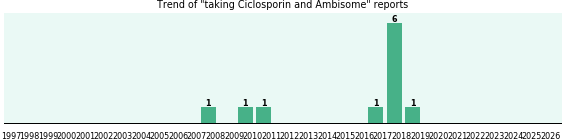
What are the common drug interactions of Ciclosporin and Ambisome, by gender? *:
female:
- Gastrointestinal disorder (functional problems of gastrointestinal tract)
- Infection
- Mucocutaneous leishmaniasis (partial or total destruction of the mucous membranes of the nose, mouth and throat cavities)
- Pathogen resistance
- Visceral leishmaniasis (black fever)
- Drug ineffective
- Abdominal pain upper
- Capillary leak syndrome (capillary leaks plasma)
- Cardiac failure acute
- Cardiac failure congestive
male:
- Anaemia (lack of blood)
- Decreased appetite
- Neutropenic sepsis (whole body infection is caused by a condition in which the number of white blood cells (called neutrophils) in the blood is low. neutrophils help the body to fight infection)
- Pallor
- Pleural effusion (water on the lungs)
- Rash
- Reversible posterior leukoencephalopathy syndrome (a brain disease with generalized seizures and headache)
- Toxic epidermal necrolysis (a rare, life-threatening skin condition that is usually caused by a reaction to drugs causes wide spread skin destruction)
- Inflammatory marker increased
- Lung disorder (lung disease)
What are the common drug interactions of Ciclosporin and Ambisome, by age (0-1 to 60+)? *:
0-1:
n/a
2-9:
- Anaemia (lack of blood)
- Decreased appetite
- Inflammatory marker increased
- Lung disorder (lung disease)
- Malabsorption (a state arising from abnormality in absorption of food nutrients across the gastrointestinal (gi) tract)
- Pancytopenia (medical condition in which there is a reduction in the number of red and white blood cells, as well as platelets)
- Capillary leak syndrome (capillary leaks plasma)
- Respiratory distress (difficulty in breathing)
10-19:
- Histiocytosis haematophagic
- Human herpesvirus 6 infection
- Hypomagnesaemia (electrolyte disturbance in which there is an abnormally low level of magnesium in the blood)
20-29:
- Bacteraemia (presence of bacteria in the blood)
- Convulsion (muscles contract and relax rapidly and repeatedly, resulting in an uncontrolled shaking of the body)
- Fall
- Neutropenic sepsis (whole body infection is caused by a condition in which the number of white blood cells (called neutrophils) in the blood is low. neutrophils help the body to fight infection)
- Pleural effusion (water on the lungs)
- Reversible posterior leukoencephalopathy syndrome (a brain disease with generalized seizures and headache)
30-39:
n/a
40-49:
- Cardiac failure acute
- Cardiac failure congestive
- Gastrointestinal haemorrhage (bleeding gastrointestinal tract)
- Hypovolaemia (a decreased volume of circulating blood in the body)
- Immunosuppressant drug level increased
- Influenza like illness
- Nausea (feeling of having an urge to vomit)
- Nephrolithiasis (calculi in the kidneys)
- Psychotic disorder
- Sleep disorder
50-59:
- Gastrointestinal disorder (functional problems of gastrointestinal tract)
- Infection
- Mucocutaneous leishmaniasis (partial or total destruction of the mucous membranes of the nose, mouth and throat cavities)
- Pathogen resistance
- Visceral leishmaniasis (black fever)
- Pallor
- Rash
- Toxic epidermal necrolysis (a rare, life-threatening skin condition that is usually caused by a reaction to drugs causes wide spread skin destruction)
60+:
n/a
What are the existing conditions these people have? *
- Epstein-Barr Virus Infection: 3 people, 27.27%
- Post Transplant Lymphoproliferative Disorder: 3 people, 27.27%
- Lung Disorder (lung disease): 3 people, 27.27%
- Immunodeficiency Disorders: 3 people, 27.27%
- Gastroesophageal Reflux Disease (a condition in which stomach contents leak backward from the stomach into the oesophagus): 2 people, 18.18%
- Visceral Leishmaniasis (black fever): 1 person, 9.09%
- Aspergillosis (an infection caused by a fungus called aspergillus): 1 person, 9.09%
- Bone Marrow Conditioning Regimen: 1 person, 9.09%
- Bronchopulmonary Aspergillosis (lung disorder caused by aspergillus fungi): 1 person, 9.09%
- Cryoglobulinaemia (blood contains large amounts of cryoglobulins - proteins): 1 person, 9.09%
* Approximation only. Some reports may have incomplete information.
Do you take Ciclosporin and Ambisome?
- Personalize this study to your gender, age, symptoms and drugs
- Predict drug outcomes for up to one year with AI
- Get an AI agent to monitor your drugs continuously
Related studies:
Effectiveness of, side effects of, and alternative drugs to the 2 drugs:
- Ciclosporin (3,571 reports)
- Ambisome (7,934 reports)
Browse all drug interactions of Ciclosporin and Ambisome:
a b c d e f g h i j k l m n o p q r s t u v w x y zSub-studies by gender and age:
Female: 0-1 2-9 10-19 20-29 30-39 40-49 50-59 60+
Male: 0-1 2-9 10-19 20-29 30-39 40-49 50-59 60+
Browse all side effects of Ciclosporin:
a b c d e f g h i j k l m n o p q r s t u v w x y zBrowse all side effects of Ambisome:
a b c d e f g h i j k l m n o p q r s t u v w x y zBrowse all interactions between Ciclosporin and drugs from A to Z:
a b c d e f g h i j k l m n o p q r s t u v w x y zBrowse all interactions between Ambisome and drugs from A to Z:
a b c d e f g h i j k l m n o p q r s t u v w x y zRelated publications that referenced our studies
- O’Brien FE, O’Connor RM, Clarke G, Donovan MD, Dinan TG, Griffin BT, Cryan JF, "The P-glycoprotein inhibitor cyclosporin A differentially influences behavioural and neurochemical responses to the antidepressant escitalopram", Behavioural brain research, 2014 Mar .
- O’Brien FE, O’Connor RM, Clarke G, Donovan MD, Dinan TG, Griffin BT, Cryan JF, "The P-glycoprotein inhibitor cyclosporin A differentially influences behavioural and neurochemical responses to the antidepressant escitalopram", Behavioural brain research, 2014 Mar .
How the study uses the data?
The study uses data from the FDA. It is based on cyclosporine and amphotericin b (the active ingredients of Ciclosporin and Ambisome, respectively), and Ciclosporin and Ambisome (the brand names). Other drugs that have the same active ingredients (e.g. generic drugs) are not considered. Dosage of drugs is not considered in the study.
How to use the study?
DO NOT STOP MEDICATIONS without first consulting your doctor. If there are any serious or long term adverse effects discovered in the study, discuss the study with your doctor to ensure that proper medication management will be in place if applicable.
Who is eHealthMe?
With medical big data and proven AI/ML algorithms, eHealthMe provides a platform for everyone to run phase IV clinical trials. We study millions of patients and 5,000 more each day. Results of our real-world drug study have been referenced on 800+ peer-reviewed medical publications, including The Lancet, Mayo Clinic Proceedings, and Nature. Our analysis results are available to researchers, health care professionals, patients (testimonials), and software developers (open API).
WARNING, DISCLAIMER, USE FOR PUBLICATION
WARNING: Please DO NOT STOP MEDICATIONS without first consulting a physician since doing so could be hazardous to your health.
DISCLAIMER: All material available on eHealthMe.com is for informational purposes only, and is not a substitute for medical advice, diagnosis, or treatment provided by a qualified healthcare provider. All information is observation-only. Our phase IV clinical studies alone cannot establish cause-effect relationship. Different individuals may respond to medication in different ways. Every effort has been made to ensure that all information is accurate, up-to-date, and complete, but no guarantee is made to that effect. The use of the eHealthMe site and its content is at your own risk.
If you use this eHealthMe study on publication, please acknowledge it with a citation: study title, URL, accessed date.
Recent studies on eHealthMe:
- Drug interactions of Vytorin and Xarelto - 6 seconds ago
- Could L-Lysine cause High Blood Cholesterol? - 7 seconds ago
- Could Ifosfamide cause Angioedema? - 17 seconds ago
- Drug interactions of Losartan Potassium and Xyrem - 19 seconds ago
- Metastases To Bone and Blood Chloride Decreased - 21 seconds ago
- Could Bactroban cause Osteoarthritis? - 23 seconds ago
- Drug interactions of Naloxone Hydrochloride and Lidocaine - 50 seconds ago
- Could Propecia cause Psoriasis? - 54 seconds ago
- Could Remicade cause Morbid Thoughts? - 58 seconds ago
- Drug interactions of Palonosetron Hydrochloride and Lenvatinib - a minute ago