Elavil and Actigall drug interactions - a phase IV clinical study of FDA data
Summary:
Drug interactions are reported among people who take Elavil (amitriptyline hydrochloride) and Actigall (ursodiol). Common drug interactions include dysphagia among females and pain among males.
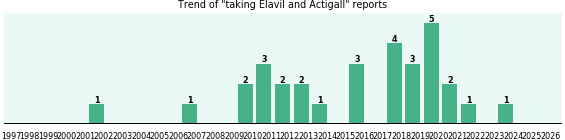
The phase IV clinical study analyzes what interactions people have when they take Elavil and Actigall. It is created by eHealthMe based on reports of 31 people who take the same drugs from the FDA, and is updated regularly.
What is Elavil?
Elavil has active ingredients of amitriptyline hydrochloride. It is often used in depression. eHealthMe is studying from 20,724 Elavil users. Check the latest studies of Elavil.
What is Actigall?
Actigall has active ingredients of ursodiol. It is often used in gallstones. eHealthMe is studying from 2,162 Actigall users. Check the latest studies of Actigall.
31 people who take Elavil and Actigall together, and have interactions are studied.
What are the common drug interactions of Elavil and Actigall, by gender? *:
female:
- Dysphagia (a condition in which swallowing is difficult or painful)
- Electrocardiogram qt prolonged
- Haematocrit decreased
- Haemoglobin decreased
- Haemoptysis (blood-stained sputum from the bronchi, larynx, trachea, or lungs)
- Hepatic fibrosis (scarring process that represents the liver's response to injury)
- Iron deficiency
- Memory impairment
- Nausea (feeling of having an urge to vomit)
- Pruritus (severe itching of the skin)
male:
- Pain
- Ankle fracture
- Colon cancer
- Cough
- Drug ineffective
- Dysphagia (a condition in which swallowing is difficult or painful)
- Increased upper airway secretion
- Joint dislocation (a joint position is changed from normal position)
- Local swelling (swelling at the site of some application of substance or injury)
- Oropharyngeal pain
What are the common drug interactions of Elavil and Actigall, by age (0-1 to 60+)? *:
0-1:
n/a
2-9:
n/a
10-19:
- Inflammatory bowel disease
- Drug toxicity
- Hypotension (abnormally low blood pressure)
- Oedema (fluid collection in tissue)
- Photophobia (extreme sensitivity to light)
- Pyrexia (fever)
- Thrombosis (formation of a blood clot inside a blood vessel)
20-29:
- Pneumonia
- Abdominal pain
- Anaemia (lack of blood)
- Cholestasis (a condition where bile cannot flow from the liver to the duodenum)
- Constipation
- Diarrhoea
- Electrocardiogram qt prolonged
- Haemoptysis (blood-stained sputum from the bronchi, larynx, trachea, or lungs)
- Iron deficiency
- Malaise (a feeling of general discomfort or uneasiness)
30-39:
- Abdominal pain upper
- Acute graft versus host disease in liver (acute complication in liver following an allogeneic tissue/blood transplant)
- Acute graft versus host disease in skin (acute complication on skin following an allogeneic tissue/blood transplant)
- Aphasia (damage to the parts of the brain that control language)
- Arthralgia (joint pain)
- Blood creatinine increased
- Blood glucose decreased
- Blood urea increased
- Chest discomfort
- Clumsiness (a lack of coordination or elegance)
40-49:
- Skin hypertrophy (skin cells enlarges)
- Skin induration (an abnormally hard spot or area on the skin)
- Skin lesion
- Skin plaque (red, scaly patches to appear on the skin)
- Swelling
- Anxiety
- Arthralgia (joint pain)
- Bone pain
- Dermatosis (a disease of the skin, esp. one that does not cause inflammation)
- Emotional distress
50-59:
- Ankle fracture
- Cellulitis (infection under the skin)
- Fall
- Lower limb fracture
- Osteoarthritis (a joint disease caused by cartilage loss in a joint)
- Osteoporosis (bones weak and more likely to break)
- Pain
- Arthritis (form of joint disorder that involves inflammation of one or more joints)
- Joint effusion (presence of extra fluid in joint covering)
- Joint dislocation (a joint position is changed from normal position)
60+:
- Diarrhoea
- Acute myocardial infarction (acute heart attack)
- Fall
- Fatigue (feeling of tiredness)
- Fistula (an abnormal connection or passageway between two)
- Gallbladder disorder
- Injury
- Local swelling (swelling at the site of some application of substance or injury)
- Lower respiratory tract infection
- Malaise (a feeling of general discomfort or uneasiness)
What are the existing conditions these people have? *
- Multiple Myeloma (cancer of the plasma cells): 7 people, 22.58%
- Nausea (feeling of having an urge to vomit): 3 people, 9.68%
- Gastroesophageal Reflux Disease (a condition in which stomach contents leak backward from the stomach into the oesophagus): 3 people, 9.68%
- Cough: 3 people, 9.68%
- Chronic Myeloid Leukaemia (long lasting type of cancer that starts in the blood-forming cells of the bone marrow and invades the blood): 3 people, 9.68%
- Thyroid Diseases: 2 people, 6.45%
- Sleep Disorder: 2 people, 6.45%
- Sinusitis (inflammation of sinus): 2 people, 6.45%
- Nuclear Magnetic Resonance Imaging Abdominal: 2 people, 6.45%
- Joint Swelling: 2 people, 6.45%
* Approximation only. Some reports may have incomplete information.
Do you take Elavil and Actigall?
- Personalize this study to your gender, age, symptoms and drugs
- Predict drug outcomes for up to one year with AI
- Get an AI agent to monitor your drugs continuously
Related studies:
Effectiveness of, side effects of, and alternative drugs to the 2 drugs:
Browse all drug interactions of Elavil and Actigall:
a b c d e f g h i j k l m n o p q r s t u v w x y zSub-studies by gender and age:
Female: 0-1 2-9 10-19 20-29 30-39 40-49 50-59 60+
Male: 0-1 2-9 10-19 20-29 30-39 40-49 50-59 60+
Browse all side effects of Elavil:
a b c d e f g h i j k l m n o p q r s t u v w x y zBrowse all side effects of Actigall:
a b c d e f g h i j k l m n o p q r s t u v w x y zBrowse all interactions between Elavil and drugs from A to Z:
a b c d e f g h i j k l m n o p q r s t u v w x y zBrowse all interactions between Actigall and drugs from A to Z:
a b c d e f g h i j k l m n o p q r s t u v w x y zRelated publications that referenced our studies
- Li W, Lamichhane J, "From Heartbreak to Left Bundle Branch Block: A Case of Amitriptyline Overdose", American Journal of Therapeutics, 2017 Sep .
- Li W, Lamichhane J, "From Heartbreak to Left Bundle Branch Block: A Case of Amitriptyline Overdose", American Journal of Therapeutics, 2017 Sep .
How the study uses the data?
The study uses data from the FDA. It is based on amitriptyline hydrochloride and ursodiol (the active ingredients of Elavil and Actigall, respectively), and Elavil and Actigall (the brand names). Other drugs that have the same active ingredients (e.g. generic drugs) are not considered. Dosage of drugs is not considered in the study.
How to use the study?
DO NOT STOP MEDICATIONS without first consulting your doctor. If there are any serious or long term adverse effects discovered in the study, discuss the study with your doctor to ensure that proper medication management will be in place if applicable.
Who is eHealthMe?
With medical big data and proven AI/ML algorithms, eHealthMe provides a platform for everyone to run phase IV clinical trials. We study millions of patients and 5,000 more each day. Results of our real-world drug study have been referenced on 800+ peer-reviewed medical publications, including The Lancet, Mayo Clinic Proceedings, and Nature. Our analysis results are available to researchers, health care professionals, patients (testimonials), and software developers (open API).
WARNING, DISCLAIMER, USE FOR PUBLICATION
WARNING: Please DO NOT STOP MEDICATIONS without first consulting a physician since doing so could be hazardous to your health.
DISCLAIMER: All material available on eHealthMe.com is for informational purposes only, and is not a substitute for medical advice, diagnosis, or treatment provided by a qualified healthcare provider. All information is observation-only. Our phase IV clinical studies alone cannot establish cause-effect relationship. Different individuals may respond to medication in different ways. Every effort has been made to ensure that all information is accurate, up-to-date, and complete, but no guarantee is made to that effect. The use of the eHealthMe site and its content is at your own risk.
If you use this eHealthMe study on publication, please acknowledge it with a citation: study title, URL, accessed date.
Recent studies on eHealthMe:
- Drug interactions of Lidoderm and Duloxetine Hydrochloride - 11 seconds ago
- Drug interactions of Xyzal and Calcium Lactate - 20 seconds ago
- Could Jardiance cause Flank Pain? - 21 seconds ago
- Drug interactions of Acetaminophen And Codeine Phosphate and Xanax - 27 seconds ago
- Could Treprostinil cause Respiratory Acidosis? - 37 seconds ago
- Drug interactions of Acebutolol Hydrochloride and Nitroglycerin - 38 seconds ago
- Could Lexapro cause Monoclonal Gammopathy? - 43 seconds ago
- Could Spiriva cause Grand Mal Convulsion? - 45 seconds ago
- Drug interactions of Abraxane and Cod Liver Oil - 47 seconds ago
- Could Simvastatin cause Formication? - a minute ago