Ketoprofen and Ambien drug interactions - a phase IV clinical study of FDA data
Summary:
Drug interactions are reported among people who take Ketoprofen (ketoprofen) and Ambien (zolpidem tartrate). Common drug interactions include intervertebral disc degeneration among females and asthenia among males.
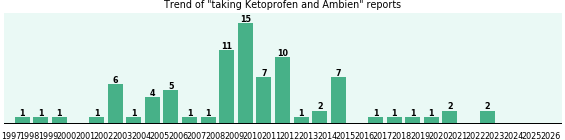
The phase IV clinical study analyzes what interactions people have when they take Ketoprofen and Ambien. It is created by eHealthMe based on reports of 83 people who take the same drugs from the FDA, and is updated regularly.
What is Ketoprofen?
Ketoprofen has active ingredients of ketoprofen. It is often used in pain. eHealthMe is studying from 15,048 Ketoprofen users. Check the latest studies of Ketoprofen.
What is Ambien?
Ambien has active ingredients of zolpidem tartrate. It is often used in insomnia. eHealthMe is studying from 93,519 Ambien users. Check the latest studies of Ambien.
eHealthMe: drug outcomes in the real world
eHealthMe runs one of the largest post-marketing drug safety studies in the world. We study millions of patients and 5,000 more each day. Our data-driven phase IV clinical trials have been referenced on 800+ peer-reviewed medical publications including The Lancet, Mayo Clinic Proceedings, and Nature. Tools to study our phase IV findings are available to the public, anonymous and free >>>.
83 people who take Ketoprofen and Ambien together, and have interactions are studied.
What are the common drug interactions of Ketoprofen and Ambien, by gender? *:
female:
- Intervertebral disc degeneration (spinal disc degeneration)
- Intervertebral disc protrusion (spinal disc protrusion)
- Pleural effusion (water on the lungs)
- Anaemia (lack of blood)
- Anhedonia (inability to experience pleasure from activities usually found enjoyable)
- Ankle fracture
- Basal cell carcinoma (a skin cancer, it rarely metastasizes or kills)
- Blood creatinine increased
- Breast cancer
- Breast cancer metastatic
male:
- Asthenia (weakness)
- Atrial fibrillation (fibrillation of the muscles of the atria of the heart)
- Cardioactive drug level above therapeutic
- Cold sweat
- Compression fracture (fracture due to pressure caused by injury)
- Fall
- Heart rate irregular
- Musculoskeletal pain (pain affects the bones, muscles, ligaments, tendons, and nerves)
- Neck pain
- Rotator cuff syndrome (a spectrum of conditions affecting the rotator cuff tendons of the shoulder)
What are the common drug interactions of Ketoprofen and Ambien, by age (0-1 to 60+)? *:
0-1:
n/a
2-9:
n/a
10-19:
n/a
20-29:
- Aortic valve incompetence
- Blood cholesterol increased
- Blood triglycerides increased
- Bronchospasm (spasm of bronchial smooth muscle producing narrowing of the bronchi)
- Chronic kidney disease
- Confusion
- Diabetes mellitus (diabetes, caused by a deficiency of the pancreatic hormone insulin)
- Electrolyte imbalance
- Infection
- Lung disorder (lung disease)
30-39:
- Amnesia (deficit in memory caused by brain damage, disease, or psychological trauma)
- Antisocial personality disorder
- Arthralgia (joint pain)
- Asthenia (weakness)
- Back pain
- Bipolar i disorder (mood disorder that is characterized by at least one manic or mixed episode)
- Coronary artery disease (plaque building up along the inner walls of the arteries of the heart, which narrows the arteries and restricts blood flow to the heart)
- Depressed mood
- Disturbance in attention
- Dizziness
40-49:
- Rash
- Delirium (wild excitement)
- Postoperative wound infection
- Renal failure acute (rapid kidney dysfunction)
- Staphylococcal infection (an infection with staphylococcus bacteria)
- Alanine aminotransferase increased
- Chest pain
- Depression
- Drug effect decreased
- Hyperhidrosis (abnormally increased sweating)
50-59:
- Compression fracture (fracture due to pressure caused by injury)
- Constipation
- Depression
- Drug abuser
- Drug ineffective
- Facial pain
- Musculoskeletal pain (pain affects the bones, muscles, ligaments, tendons, and nerves)
- Oedema peripheral (superficial swelling)
- Palpitations (feelings or sensations that your heart is pounding or racing)
- Panic attack
60+:
- Anxiety
- Anhedonia (inability to experience pleasure from activities usually found enjoyable)
- Blood creatinine increased
- Breast cancer
- Breast cancer metastatic
- Cervix haemorrhage uterine (bleeding from cervix in birth canal)
- Disability
- Epicondylitis (tennis elbow)
- Herpes zoster
- Hypercholesterolaemia (high levels of cholesterol in the blood)
What are the existing conditions these people have? *
- High Blood Pressure: 14 people, 16.87%
- Depression: 12 people, 14.46%
- Hypercalcaemia (elevated calcium (ca+) level in the blood): 11 people, 13.25%
- Anaemia (lack of blood): 11 people, 13.25%
- Sleep Disorder: 8 people, 9.64%
- Headache (pain in head): 6 people, 7.23%
- Diabetes: 6 people, 7.23%
* Approximation only. Some reports may have incomplete information.
Do you take Ketoprofen and Ambien?
- Personalize this study to your gender, age, symptoms and drugs
- Predict drug outcomes for up to one year with AI
- Get an AI agent to monitor your drugs continuously
Related studies:
Effectiveness of, side effects of, and alternative drugs to the 2 drugs:
- Ketoprofen (15,048 reports)
- Ambien (93,519 reports)
Browse all drug interactions of Ketoprofen and Ambien:
a b c d e f g h i j k l m n o p q r s t u v w x y zSub-studies by gender and age:
Female: 0-1 2-9 10-19 20-29 30-39 40-49 50-59 60+
Male: 0-1 2-9 10-19 20-29 30-39 40-49 50-59 60+
Browse all side effects of Ketoprofen:
a b c d e f g h i j k l m n o p q r s t u v w x y zBrowse all side effects of Ambien:
a b c d e f g h i j k l m n o p q r s t u v w x y zBrowse all interactions between Ketoprofen and drugs from A to Z:
a b c d e f g h i j k l m n o p q r s t u v w x y zBrowse all interactions between Ambien and drugs from A to Z:
a b c d e f g h i j k l m n o p q r s t u v w x y zRelated publications that referenced our studies
- Hsu FG, Sheu MJ, Lin CL, Hsieh YW, Lai SW, "Use of Zolpidem and Risk of Acute Pyelonephritis in Women: A Population‐Based Case‐Control Study in Taiwan", The Journal of Clinical Pharmacology, 2017 Mar .
- Lin SC, Su YC, Huang YS, Lee CC, "Zolpidem increased cancer risk in patients with sleep disorder: A 3-year follow-up study", Journal of Medical Sciences, 2016 Mar .
- Sun Y, Lin CC, Lu CJ, Hsu CY, Kao CH, "Association between zolpidem and suicide: a nationwide population-based case-control study", InMayo Clinic Proceedings, 2016 Mar .
- Liao KF, Lin CL, Lai SW, Chen WC, "Zolpidem use associated with increased risk of pyogenic liver abscess: a case-control study in Taiwan", Medicine, 2015 Jan .
- Hsu FG, Sheu MJ, Lin CL, Hsieh YW, Lai SW, "Use of Zolpidem and Risk of Acute Pyelonephritis in Women: A Population‐Based Case‐Control Study in Taiwan", The Journal of Clinical Pharmacology, 2017 Mar .
- Lin SC, Su YC, Huang YS, Lee CC, "Zolpidem increased cancer risk in patients with sleep disorder: A 3-year follow-up study", Journal of Medical Sciences, 2016 Mar .
- Sun Y, Lin CC, Lu CJ, Hsu CY, Kao CH, "Association between zolpidem and suicide: a nationwide population-based case-control study", InMayo Clinic Proceedings, 2016 Mar .
- Liao KF, Lin CL, Lai SW, Chen WC, "Zolpidem use associated with increased risk of pyogenic liver abscess: a case-control study in Taiwan", Medicine, 2015 Jan .
How the study uses the data?
The study uses data from the FDA. It is based on ketoprofen and zolpidem tartrate (the active ingredients of Ketoprofen and Ambien, respectively), and Ketoprofen and Ambien (the brand names). Other drugs that have the same active ingredients (e.g. generic drugs) are not considered. Dosage of drugs is not considered in the study.
How to use the study?
DO NOT STOP MEDICATIONS without first consulting your doctor. If there are any serious or long term adverse effects discovered in the study, discuss the study with your doctor to ensure that proper medication management will be in place if applicable.
Who is eHealthMe?
With medical big data and proven AI/ML algorithms, eHealthMe provides a platform for everyone to run phase IV clinical trials. We study millions of patients and 5,000 more each day. Results of our real-world drug study have been referenced on 800+ peer-reviewed medical publications, including The Lancet, Mayo Clinic Proceedings, and Nature. Our analysis results are available to researchers, health care professionals, patients (testimonials), and software developers (open API).
WARNING, DISCLAIMER, USE FOR PUBLICATION
WARNING: Please DO NOT STOP MEDICATIONS without first consulting a physician since doing so could be hazardous to your health.
DISCLAIMER: All material available on eHealthMe.com is for informational purposes only, and is not a substitute for medical advice, diagnosis, or treatment provided by a qualified healthcare provider. All information is observation-only. Our phase IV clinical studies alone cannot establish cause-effect relationship. Different individuals may respond to medication in different ways. Every effort has been made to ensure that all information is accurate, up-to-date, and complete, but no guarantee is made to that effect. The use of the eHealthMe site and its content is at your own risk.
If you use this eHealthMe study on publication, please acknowledge it with a citation: study title, URL, accessed date.
Recent studies on eHealthMe:
- Gout and Glaucoma - now
- Could Plendil cause Diabetes Mellitus Non-Insulin-Dependent? - 5 seconds ago
- Could Plendil cause Type 2 Diabetes? - 5 seconds ago
- Could Hctz cause Muscle Rupture? - 11 seconds ago
- Psoriatic Arthropathy and Dizziness - 16 seconds ago
- Could Remicade cause Oedema Mouth? - 18 seconds ago
- Could Remicade cause Erythema Multiforme? - 24 seconds ago
- Could Cabometyx cause Dizziness Aggravated? - 24 seconds ago
- Drug interactions of Allegra and Tranexamic Acid - 24 seconds ago
- Could Mirtazapine cause Wound Infection Staphylococcal? - 25 seconds ago