Keppra and Optic atrophy - a phase IV clinical study of FDA data
Summary:
Optic atrophy is reported as a side effect among people who take Keppra (levetiracetam), especially for people who are female, 60+ old, have been taking the drug for < 1 month also take Prilosec, and have Gastroesophageal reflux disease.
The phase IV clinical study analyzes which people have Optic atrophy when taking Keppra. It is created by eHealthMe based on reports of 70,297 people who have side effects when taking Keppra from the FDA, and is updated regularly.
What is Keppra?
Keppra has active ingredients of levetiracetam. It is often used in epilepsy. eHealthMe is studying from 73,504 Keppra users. Check the latest studies of Keppra.
What is Optic atrophy?
Optic atrophy (the loss of a proportion of optic disc nerve fibres) is found to be associated with 249 drugs and 453 conditions by eHealthMe. Check the latest studies of Optic atrophy.
70,297 people reported to have side effects when taking Keppra.
Among them, 32 people (0.05%) have Optic atrophy.
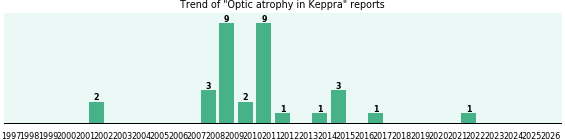
Among these 32 people:
How long have people been on Keppra when they have Optic atrophy? *
- < 1 month: 100 %
- 1 - 6 months: 0.0 %
- 6 - 12 months: 0.0 %
- 1 - 2 years: 0.0 %
- 2 - 5 years: 0.0 %
- 5 - 10 years: 0.0 %
- 10+ years: 0.0 %
What is the gender of people who have Optic atrophy when taking Keppra? *
- female: 53.33 %
- male: 46.67 %
What is the age of people who have Optic atrophy when taking Keppra? *
- 0-1: 4.35 %
- 2-9: 8.7 %
- 10-19: 4.35 %
- 20-29: 4.35 %
- 30-39: 21.74 %
- 40-49: 8.7 %
- 50-59: 21.74 %
- 60+: 26.09 %
What are other drugs people take besides Keppra? *
- Miralax: 7 people, 21.88%
- Prilosec: 7 people, 21.88%
- Zovirax: 6 people, 18.75%
- Nitrostat: 6 people, 18.75%
- Niaspan: 6 people, 18.75%
- Niacin: 6 people, 18.75%
- Nexium: 6 people, 18.75%
- Nasacort Aq: 6 people, 18.75%
- Nabumetone: 6 people, 18.75%
- Macrobid: 6 people, 18.75%
What are other side effects people have besides Optic atrophy? *
- Visual Field Defect: 10 people, 31.25%
- Visual Acuity Reduced (reduced clearness of vision): 8 people, 25.00%
- Balance Disorder: 7 people, 21.88%
- Sensation Of Foreign Body: 6 people, 18.75%
- Tardive Dyskinesia (a disorder that involves involuntary movements): 6 people, 18.75%
- Rhinalgia (pain in the nose): 6 people, 18.75%
- Neck Pain: 6 people, 18.75%
- Fall: 6 people, 18.75%
- Swallowing Difficulty: 6 people, 18.75%
- Excoriation (to tear or wear off the skin of): 6 people, 18.75%
What are the existing conditions these people have? *
- Gastroesophageal Reflux Disease (a condition in which stomach contents leak backward from the stomach into the oesophagus): 6 people, 18.75%
- Temporal Lobe Epilepsy (a term that refers to a condition where seizures are generated in the portion of the brain called the temporal lobe): 1 person, 3.12%
- Angiofibroma (small, reddish brown or even flesh-coloured, smooth, shiny, 0.1- to 0.3 cm papules present over the sides of the nose and the medial portions of the cheeks): 1 person, 3.12%
- Arthritis (form of joint disorder that involves inflammation of one or more joints): 1 person, 3.12%
- Bronchospasm (spasm of bronchial smooth muscle producing narrowing of the bronchi): 1 person, 3.12%
- Complex Partial Seizures (epileptic seizure): 1 person, 3.12%
- Constipation: 1 person, 3.12%
- Convulsion (muscles contract and relax rapidly and repeatedly, resulting in an uncontrolled shaking of the body): 1 person, 3.12%
- Drug Exposure During Pregnancy: 1 person, 3.12%
- Eye Pruritus (eye itching): 1 person, 3.12%
* Approximation only. Some reports may have incomplete information.
Do you take Keppra and have Optic atrophy?
- Check whether Optic atrophy is associated with a drug or a condition
- Predict drug outcomes for up to one year with AI
- Get an AI agent to monitor your drugs continuously
Related studies:
Effectiveness of, long term effects of, and alternative drugs to Keppra:
- Keppra (73,504 reports)
Optic atrophy treatments and more:
- Optic atrophy (2,242 reports)
How severe was Optic atrophy and when was it recovered:
Expand to all the drugs that have ingredients of levetiracetam:
Sub-studies by gender and age:
Female: 0-1 2-9 10-19 20-29 30-39 40-49 50-59 60+
Male: 0-1 2-9 10-19 20-29 30-39 40-49 50-59 60+
Browse all side effects of Keppra:
a b c d e f g h i j k l m n o p q r s t u v w x y zBrowse all the drugs that are associated with Optic atrophy:
- Optic atrophy (249 drugs)
Browse all the conditions that are associated with Optic atrophy:
- Optic atrophy (453 conditions)
Related publications that referenced our studies
- Schattner A, Al-Bewerat A, "Levetiracetam (Keppra), urinary retention and literature search", A fatty cause of renal failure; what is your diagnosis?, 2016 Oct .
- Spengler DC, Montouris GD, Hohler AD, "Levetiracetam as a possible contributor to acute kidney injury", Clinical therapeutics, 2014 Aug .
- Almeida DM, Jean MR, Chystsiakova A, Monahan E, Oliveira SB, Monteiro IM, "Levetiracetam-associated acute pancreatitis in an adolescent with autism: a case report", Pancreas, 2013 Jan .
- Schattner A, Al-Bewerat A, "Levetiracetam (Keppra), urinary retention and literature search", A fatty cause of renal failure; what is your diagnosis?, 2016 Oct .
- Spengler DC, Montouris GD, Hohler AD, "Levetiracetam as a possible contributor to acute kidney injury", Clinical therapeutics, 2014 Aug .
- Almeida DM, Jean MR, Chystsiakova A, Monahan E, Oliveira SB, Monteiro IM, "Levetiracetam-associated acute pancreatitis in an adolescent with autism: a case report", Pancreas, 2013 Jan .
How the study uses the data?
The study uses data from the FDA. It is based on levetiracetam (the active ingredients of Keppra) and Keppra (the brand name). Other drugs that have the same active ingredients (e.g. generic drugs) are not considered. Dosage of drugs is not considered in the study.
How to use the study?
DO NOT STOP MEDICATIONS without first consulting your doctor. If there are any serious or long term adverse effects discovered in the study, discuss the study with your doctor to ensure that proper medication management will be in place if applicable.
Who is eHealthMe?
With medical big data and proven AI/ML algorithms, eHealthMe provides a platform for everyone to run phase IV clinical trials. We study millions of patients and 5,000 more each day. Results of our real-world drug study have been referenced on 800+ peer-reviewed medical publications, including The Lancet, Mayo Clinic Proceedings, and Nature. Our analysis results are available to researchers, health care professionals, patients (testimonials), and software developers (open API).
WARNING, DISCLAIMER, USE FOR PUBLICATION
WARNING: Please DO NOT STOP MEDICATIONS without first consulting a physician since doing so could be hazardous to your health.
DISCLAIMER: All material available on eHealthMe.com is for informational purposes only, and is not a substitute for medical advice, diagnosis, or treatment provided by a qualified healthcare provider. All information is observation-only. Our phase IV clinical studies alone cannot establish cause-effect relationship. Different individuals may respond to medication in different ways. Every effort has been made to ensure that all information is accurate, up-to-date, and complete, but no guarantee is made to that effect. The use of the eHealthMe site and its content is at your own risk.
If you use this eHealthMe study on publication, please acknowledge it with a citation: study title, URL, accessed date.
Recent studies on eHealthMe:
- Wegovy vs. Crestor, side effect and effectiveness comparison - now
- Valium vs. Haloperidol, side effect and effectiveness comparison - 2 seconds ago
- Drug interactions of Amlodipine and Glucotrol Xl - 17 seconds ago
- Drug interactions of Gemcitabine Hydrochloride and Vitamins - 21 seconds ago
- Hydrocodone Bitartrate And Ibuprofen vs. Hydrocortisone, side effect and effectiveness comparison - 27 seconds ago
- Drug interactions of Losartan and Belbuca - 27 seconds ago
- Could Acetaminophen And Codeine Phosphate cause Intra-Uterine Death? - 33 seconds ago
- Could Doxycycline cause Pancreatitis Acute? - 42 seconds ago
- Drug interactions of Dupixent and Kalydeco - 46 seconds ago
- How effective is Fioricet for Migraine? - a minute ago