Zestril and Vyvanse drug interactions - a phase IV clinical study of FDA data
Summary:
Drug interactions are reported among people who take Zestril (lisinopril) and Vyvanse (lisdexamfetamine dimesylate). Common drug interactions include abdominal distension among females and therapeutic response unexpected among males.
The phase IV clinical study analyzes what interactions people have when they take Zestril and Vyvanse. It is created by eHealthMe based on reports of 18 people who take the same drugs from the FDA, and is updated regularly.
What is Zestril?
Zestril has active ingredients of lisinopril. It is often used in high blood pressure. eHealthMe is studying from 22,273 Zestril users. Check the latest studies of Zestril.
What is Vyvanse?
Vyvanse has active ingredients of lisdexamfetamine dimesylate. It is often used in attention deficit hyperactivity disorder. eHealthMe is studying from 35,868 Vyvanse users. Check the latest studies of Vyvanse.
18 people who take Zestril and Vyvanse together, and have interactions are studied.
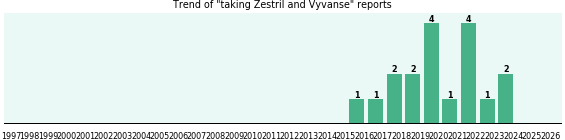
What are the common drug interactions of Zestril and Vyvanse, by gender? *:
female:
- Abdominal distension
- Asthma
- Facial paralysis (loss of function of face muscle)
- Folliculitis (infection of hair root)
- Heart rate increased
- Influenza
- Infusion site erythema (reddening of the skin at infusion site)
- Infusion site pruritus (severe itching at infusion site)
- Malaise (a feeling of general discomfort or uneasiness)
- Oral surgery
male:
- Therapeutic response unexpected
- Anger
- Anxiety
- Chronic kidney disease
What are the common drug interactions of Zestril and Vyvanse, by age (0-1 to 60+)? *:
0-1:
n/a
2-9:
n/a
10-19:
n/a
20-29:
n/a
30-39:
n/a
40-49:
- Anger
- Anxiety
- Chronic kidney disease
50-59:
- Breast injury
- Infusion site pruritus (severe itching at infusion site)
- Malaise (a feeling of general discomfort or uneasiness)
- Oral surgery
- Sinus disorder (disease of sinus)
- Sinusitis (inflammation of sinus)
- Skin infection
- Upper respiratory tract infection
- Mental disorder (a psychological term for a mental or behavioural pattern or anomaly that causes distress or disability)
- Ovarian neoplasm (tumour of ovary)
60+:
- Therapeutic response unexpected
What are the existing conditions these people have? *
- Cataplexy (loss of muscle tone accompanied by full conscious awareness): 6 people, 33.33%
- Narcolepsy (brain's inability to regulate sleep-wake cycles normally): 6 people, 33.33%
- Immunodeficiency Common Variable: 5 people, 27.78%
- Fatigue (feeling of tiredness): 4 people, 22.22%
- Relapsing-Remitting Multiple Sclerosis (reoccurrence of an inflammatory disease in which the insulating covers of nerve cells in the brain and spinal cord are damaged): 4 people, 22.22%
- Pain: 4 people, 22.22%
- Trigeminal Neuralgia (a painful condition of the nerve responsible for most facial sensation): 4 people, 22.22%
- Wheezing (a high-pitched whistling sound made while you breath): 1 person, 5.56%
- Bipolar Disorder (mood disorder): 1 person, 5.56%
- Cough: 1 person, 5.56%
* Approximation only. Some reports may have incomplete information.
Do you take Zestril and Vyvanse?
- Personalize this study to your gender, age, symptoms and drugs
- Predict drug outcomes for up to one year with AI
- Get an AI agent to monitor your drugs continuously
Related studies:
Effectiveness of, side effects of, and alternative drugs to the 2 drugs:
Browse all drug interactions of Zestril and Vyvanse:
a b c d e f g h i j k l m n o p q r s t u v w x y zSub-studies by gender and age:
Female: 0-1 2-9 10-19 20-29 30-39 40-49 50-59 60+
Male: 0-1 2-9 10-19 20-29 30-39 40-49 50-59 60+
Browse all side effects of Zestril:
a b c d e f g h i j k l m n o p q r s t u v w x y zBrowse all side effects of Vyvanse:
a b c d e f g h i j k l m n o p q r s t u v w x y zBrowse all interactions between Zestril and drugs from A to Z:
a b c d e f g h i j k l m n o p q r s t u v w x y zBrowse all interactions between Vyvanse and drugs from A to Z:
a b c d e f g h i j k l m n o p q r s t u v w x y zRelated publications that referenced our studies
- Najib J, Wimer D, Zeng J, Lam KW, Romanyak N, Paige Morgan E, Thadavila A, "Review of Lisdexamfetamine Dimesylate in Adults With Attention-Deficit/Hyperactivity Disorder", Journal of central nervous system disease, 2017 Aug .
- Maneeton N, Maneeton B, Suttajit S, Reungyos J, Srisurapanont M, Martin SD, "Exploratory meta-analysis on lisdexamfetamine versus placebo in adult ADHD", Drug design, development and therapy, 2017 Jan .
- Maneeton B, Maneeton N, Likhitsathian S, Suttajit S, Narkpongphun A, Srisurapanont M, Woottiluk P, "Comparative efficacy, acceptability, and tolerability of lisdexamfetamine in child and adolescent ADHD: a meta-analysis of randomized, controlled trials", Drug design, development and therapy, 2013 Jan .
- Dobrosavljevi? Vukojevi? D, Stojkovi? Filipovi? J, Sjerobabin M, Vukovi? J, Vesi? S, "Lisinopril-induced pemphigus foliaceus in a patient with diabetes mellitus and Kaposi-Juliusberg varicelliform eruption", Serbian Journal of Dermatology and Venerology, 2012 Dec .
- Najib J, Wimer D, Zeng J, Lam KW, Romanyak N, Paige Morgan E, Thadavila A, "Review of Lisdexamfetamine Dimesylate in Adults With Attention-Deficit/Hyperactivity Disorder", Journal of central nervous system disease, 2017 Aug .
- Maneeton N, Maneeton B, Suttajit S, Reungyos J, Srisurapanont M, Martin SD, "Exploratory meta-analysis on lisdexamfetamine versus placebo in adult ADHD", Drug design, development and therapy, 2017 Jan .
- Maneeton B, Maneeton N, Likhitsathian S, Suttajit S, Narkpongphun A, Srisurapanont M, Woottiluk P, "Comparative efficacy, acceptability, and tolerability of lisdexamfetamine in child and adolescent ADHD: a meta-analysis of randomized, controlled trials", Drug design, development and therapy, 2013 Jan .
- Dobrosavljevi? Vukojevi? D, Stojkovi? Filipovi? J, Sjerobabin M, Vukovi? J, Vesi? S, "Lisinopril-induced pemphigus foliaceus in a patient with diabetes mellitus and Kaposi-Juliusberg varicelliform eruption", Serbian Journal of Dermatology and Venerology, 2012 Dec .
How the study uses the data?
The study uses data from the FDA. It is based on lisinopril and lisdexamfetamine dimesylate (the active ingredients of Zestril and Vyvanse, respectively), and Zestril and Vyvanse (the brand names). Other drugs that have the same active ingredients (e.g. generic drugs) are not considered. Dosage of drugs is not considered in the study.
How to use the study?
DO NOT STOP MEDICATIONS without first consulting your doctor. If there are any serious or long term adverse effects discovered in the study, discuss the study with your doctor to ensure that proper medication management will be in place if applicable.
Who is eHealthMe?
With medical big data and proven AI/ML algorithms, eHealthMe provides a platform for everyone to run phase IV clinical trials. We study millions of patients and 5,000 more each day. Results of our real-world drug study have been referenced on 800+ peer-reviewed medical publications, including The Lancet, Mayo Clinic Proceedings, and Nature. Our analysis results are available to researchers, health care professionals, patients (testimonials), and software developers (open API).
WARNING, DISCLAIMER, USE FOR PUBLICATION
WARNING: Please DO NOT STOP MEDICATIONS without first consulting a physician since doing so could be hazardous to your health.
DISCLAIMER: All material available on eHealthMe.com is for informational purposes only, and is not a substitute for medical advice, diagnosis, or treatment provided by a qualified healthcare provider. All information is observation-only. Our phase IV clinical studies alone cannot establish cause-effect relationship. Different individuals may respond to medication in different ways. Every effort has been made to ensure that all information is accurate, up-to-date, and complete, but no guarantee is made to that effect. The use of the eHealthMe site and its content is at your own risk.
If you use this eHealthMe study on publication, please acknowledge it with a citation: study title, URL, accessed date.
Recent studies on eHealthMe:
- Drug interactions of Abilify and Haloperidol Lactate - 2 seconds ago
- Could Warfarin Sodium cause Chest X-Ray Abnormal? - 2 seconds ago
- Could Lovaza cause Speech Disorder? - 2 seconds ago
- Could Advil cause Hepatic Encephalopathy? - 10 seconds ago
- Drug interactions of Comtan and Ramipril - 11 seconds ago
- Could Daypro cause The Flu? - 16 seconds ago
- Drug interactions of Bentyl and Atorvastatin Calcium - 22 seconds ago
- Drug interactions of Genvoya and Detrol - 29 seconds ago
- Drug interactions of Azelastine and Tikosyn - 34 seconds ago
- Drug interactions of Nexium and Terconazole - 37 seconds ago