Chlorhexidine gluconate and Zanaflex drug interactions - a phase IV clinical study of FDA data
Summary:
Drug interactions are reported among people who take Chlorhexidine gluconate (chlorhexidine gluconate) and Zanaflex (tizanidine hydrochloride). Common drug interactions include tooth disorder among females and anxiety among males.
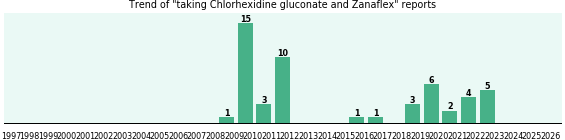
The phase IV clinical study analyzes what interactions people have when they take Chlorhexidine gluconate and Zanaflex. It is created by eHealthMe based on reports of 51 people who take the same drugs from the FDA, and is updated regularly.
What is Chlorhexidine gluconate?
Chlorhexidine gluconate has active ingredients of chlorhexidine gluconate. eHealthMe is studying from 8,233 Chlorhexidine gluconate users. Check the latest studies of Chlorhexidine gluconate.
What is Zanaflex?
Zanaflex has active ingredients of tizanidine hydrochloride. It is often used in muscle spasms. eHealthMe is studying from 17,476 Zanaflex users. Check the latest studies of Zanaflex.
51 people who take Chlorhexidine gluconate and Zanaflex together, and have interactions are studied.
What are the common drug interactions of Chlorhexidine Gluconate and Zanaflex, by gender? *:
female:
- Tooth disorder (tooth disease)
- Nausea (feeling of having an urge to vomit)
- Pyrexia (fever)
- Anaemia (lack of blood)
- Anxiety
- Constipation
- Hypertension (high blood pressure)
- Oedema peripheral (superficial swelling)
- Abdominal pain
- Abdominal pain upper
male:
- Anxiety
- Arthralgia (joint pain)
- Hypophagia (reduced food intake)
- Injury
- Intervertebral disc degeneration (spinal disc degeneration)
- Sciatica (a set of symptoms including pain caused by general compression or irritation of one of five spinal nerve roots of each sciatic nerve)
- Arthropathy
- Haematochezia (passage of stools containing blood)
- Post laminectomy syndrome
- Spondylitis (an inflammation of the vertebra with spinal cord involvement)
What are the common drug interactions of Chlorhexidine Gluconate and Zanaflex, by age (0-1 to 60+)? *:
0-1:
n/a
2-9:
n/a
10-19:
- Deep vein thrombosis (blood clot in a major vein that usually develops in the legs and/or pelvis)
- Pulmonary embolism (blockage of the main artery of the lung)
20-29:
- Deep vein thrombosis (blood clot in a major vein that usually develops in the legs and/or pelvis)
- Pulmonary embolism (blockage of the main artery of the lung)
30-39:
n/a
40-49:
- Fatigue (feeling of tiredness)
- Abdominal pain
- Abdominal pain upper
- Actinomycosis (infection that causes sores, or abscesses)
- Adverse drug reaction
- Anaemia (lack of blood)
- Angiopathy (generic term for a disease of the blood vessels)
- Anhedonia (inability to experience pleasure from activities usually found enjoyable)
- Anxiety
- Arthritis (form of joint disorder that involves inflammation of one or more joints)
50-59:
- Bacteraemia (presence of bacteria in the blood)
- Bone disorder
- Bone erosion
- Bone fragmentation
- Congestive cardiomyopathy (weakening of heart muscle)
- Dental fistula
- Dermatitis (inflammation of the skin resulting from direct irritation by an external agent or an allergic reaction to it)
- Eczema (patches of skin become rough and inflamed, with itching and bleeding blisters)
- Eczema asteatotic (severe dry skin- during the winter months and in the elderly)
- Excessive granulation tissue (excessive collagen-rich tissue which forms at the site of an injury)
60+:
- Bone loss
- Cardiomegaly (increased size of heart than normal)
- Non-hodgkin's lymphoma (malignant (cancer) cells form in the lymph system)
- Osteonecrosis of jaw (death of bone of jaw)
- Ovarian cyst (fluid filled sac of the ovary)
- Periarthritis (inflammation of the external coats of an artery and of the tissues around the artery)
- Pulmonary arterial hypertension (high blood pressure in the arteries of lungs)
- Quality of life decreased
- Road traffic accident
- Tooth loss
What are the existing conditions these people have? *
- Multiple Myeloma (cancer of the plasma cells): 27 people, 52.94%
- Gastroesophageal Reflux Disease (a condition in which stomach contents leak backward from the stomach into the oesophagus): 17 people, 33.33%
- High Blood Pressure: 15 people, 29.41%
- Fatigue (feeling of tiredness): 14 people, 27.45%
- Immunodeficiency Common Variable: 10 people, 19.61%
- Pain: 6 people, 11.76%
- Metastases To Bone (cancer spreads to bone): 4 people, 7.84%
- Stress And Anxiety: 3 people, 5.88%
- Narcolepsy (brain's inability to regulate sleep-wake cycles normally): 3 people, 5.88%
- Inflammation: 3 people, 5.88%
* Approximation only. Some reports may have incomplete information.
Do you take Chlorhexidine gluconate and Zanaflex?
- Personalize this study to your gender, age, symptoms and drugs
- Predict drug outcomes for up to one year with AI
- Get an AI agent to monitor your drugs continuously
Related studies:
Effectiveness of, side effects of, and alternative drugs to the 2 drugs:
- Chlorhexidine gluconate (8,233 reports)
- Zanaflex (17,476 reports)
Browse all drug interactions of Chlorhexidine gluconate and Zanaflex:
a b c d e f g h i j k l m n o p q r s t u v w x y zSub-studies by gender and age:
Female: 0-1 2-9 10-19 20-29 30-39 40-49 50-59 60+
Male: 0-1 2-9 10-19 20-29 30-39 40-49 50-59 60+
Browse all side effects of Chlorhexidine gluconate:
a b c d e f g h i j k l m n o p q r s t u v w x y zBrowse all side effects of Zanaflex:
a b c d e f g h i j k l m n o p q r s t u v w x y zBrowse all interactions between Chlorhexidine gluconate and drugs from A to Z:
a b c d e f g h i j k l m n o p q r s t u v w x y zBrowse all interactions between Zanaflex and drugs from A to Z:
a b c d e f g h i j k l m n o p q r s t u v w x y zHow the study uses the data?
The study uses data from the FDA. It is based on chlorhexidine gluconate and tizanidine hydrochloride (the active ingredients of Chlorhexidine gluconate and Zanaflex, respectively), and Chlorhexidine gluconate and Zanaflex (the brand names). Other drugs that have the same active ingredients (e.g. generic drugs) are not considered. Dosage of drugs is not considered in the study.
How to use the study?
DO NOT STOP MEDICATIONS without first consulting your doctor. If there are any serious or long term adverse effects discovered in the study, discuss the study with your doctor to ensure that proper medication management will be in place if applicable.
Who is eHealthMe?
With medical big data and proven AI/ML algorithms, eHealthMe provides a platform for everyone to run phase IV clinical trials. We study millions of patients and 5,000 more each day. Results of our real-world drug study have been referenced on 800+ peer-reviewed medical publications, including The Lancet, Mayo Clinic Proceedings, and Nature. Our analysis results are available to researchers, health care professionals, patients (testimonials), and software developers (open API).
WARNING, DISCLAIMER, USE FOR PUBLICATION
WARNING: Please DO NOT STOP MEDICATIONS without first consulting a physician since doing so could be hazardous to your health.
DISCLAIMER: All material available on eHealthMe.com is for informational purposes only, and is not a substitute for medical advice, diagnosis, or treatment provided by a qualified healthcare provider. All information is observation-only. Our phase IV clinical studies alone cannot establish cause-effect relationship. Different individuals may respond to medication in different ways. Every effort has been made to ensure that all information is accurate, up-to-date, and complete, but no guarantee is made to that effect. The use of the eHealthMe site and its content is at your own risk.
If you use this eHealthMe study on publication, please acknowledge it with a citation: study title, URL, accessed date.
Recent studies on eHealthMe:
- Drug interactions of Sertraline and Epivir - now
- Drug interactions of Cetirizine Hydrochloride and Norvasc - 5 seconds ago
- Could Moduretic 5-50 cause Myopathy? - 19 seconds ago
- Drug interactions of Desmopressin Acetate and Profen - 37 seconds ago
- Drug interactions of Iodine and Lipitor - 38 seconds ago
- Could Amlodipine Besylate cause Pneumocystis Jiroveci Pneumonia? - 50 seconds ago
- Could Cimzia cause Disability? - 59 seconds ago
- Drug interactions of Flexeril and Lidex - a minute ago
- Drug interactions of Zyvox and Protamine Sulfate - a minute ago
- Could Mirapex cause Myasthenia Gravis Aggravated? - a minute ago