Soolantra and Profen drug interactions - a phase IV clinical study of FDA data
Summary:
Drug interactions are reported among people who take Soolantra (ivermectin) and Profen (ibuprofen). Common drug interactions include hyperhidrosis among females and bronchitis among males.
The phase IV clinical study analyzes what interactions people have when they take Soolantra and Profen. It is created by eHealthMe based on reports of 37 people who take the same drugs from the FDA, and is updated regularly.
What is Soolantra?
Soolantra has active ingredients of ivermectin. eHealthMe is studying from 1,068 Soolantra users. Check the latest studies of Soolantra.
What is Profen?
Profen has active ingredients of ibuprofen. It is often used in pain. eHealthMe is studying from 245,311 Profen users. Check the latest studies of Profen.
37 people who take Soolantra and Profen together, and have interactions are studied.
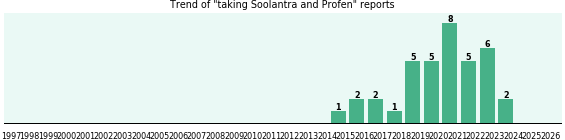
What are the common drug interactions of Soolantra and Profen, by gender? *:
female:
- Hyperhidrosis (abnormally increased sweating)
- Hypokalaemia (low potassium)
- Injection site pain
- Limb injury
- Muscular weakness (muscle weakness)
- Oxygen saturation decreased
- Rash papular (redness with papule)
- Rash pruritic (redness with itching)
- Rash pustular (redness with pustules)
- Restlessness (not able to rest)
male:
- Bronchitis (inflammation of the mucous membrane in the bronchial tubes)
- Exposure to toxic agent
- Infusion site discomfort
- Infusion site mass
- Infusion site pain
- Infusion site pruritus (severe itching at infusion site)
- Injection site mass
- Injection site pain
- Mental disorder (a psychological term for a mental or behavioural pattern or anomaly that causes distress or disability)
- Migraine (headache)
What are the common drug interactions of Soolantra and Profen, by age (0-1 to 60+)? *:
0-1:
n/a
2-9:
n/a
10-19:
n/a
20-29:
n/a
30-39:
- Injection site pain
- Rash pruritic (redness with itching)
40-49:
- Erythema (redness of the skin)
- Pain of skin
- Rash macular (small, flat red spots)
- Skin burning sensation
- Discomfort
- Eye pain
- Frequent bowel movements
- Hyperhidrosis (abnormally increased sweating)
- Restlessness (not able to rest)
- Fatigue (feeling of tiredness)
50-59:
- Arthralgia (joint pain)
- Nausea (feeling of having an urge to vomit)
- Cervical cyst (mucus-filled cyst on the surface of the cervix)
- Diarrhoea
- Dry skin
- Flatulence (flatus expelled through the anus)
- Leukopenia (less number of white blood cells in blood)
- Mucosal dryness (dryness of mucous membrane)
- Muscle spasms (muscle contraction)
- Myalgia (muscle pain)
60+:
- Chronic kidney disease
- Death
- Rosacea (a skin condition that causes facial redness)
- Skin irritation
- Syncope (loss of consciousness with an inability to maintain postural tone)
- Tendonitis (a condition that causes pain and swelling of tendons)
- Toothache (tooth pain)
- Dermatitis (inflammation of the skin resulting from direct irritation by an external agent or an allergic reaction to it)
- Dermatitis allergic (inflammation of the skin due allergic reaction)
- Erythema (redness of the skin)
What are the existing conditions these people have? *
- Fibromyalgia (a long-term condition which causes pain all over the body): 13 people, 35.14%
- Hypothyroidism (abnormally low activity of the thyroid gland, resulting in retardation of growth and mental development): 5 people, 13.51%
- Rosacea (a skin condition that causes facial redness): 5 people, 13.51%
- Depression: 4 people, 10.81%
- Malignant Melanoma (skin cancer rises from melancytes): 4 people, 10.81%
- Stress And Anxiety: 4 people, 10.81%
- Constipation: 3 people, 8.11%
- Diabetic Neuropathy (neuropathic disorders that are associated with diabetes mellitus): 3 people, 8.11%
- Dyspnea (difficult or laboured breathing): 3 people, 8.11%
- Eczema (patches of skin become rough and inflamed, with itching and bleeding blisters): 3 people, 8.11%
* Approximation only. Some reports may have incomplete information.
Do you take Soolantra and Profen?
- Personalize this study to your gender, age, symptoms and drugs
- Predict drug outcomes for up to one year with AI
- Get an AI agent to monitor your drugs continuously
Related studies:
Effectiveness of, side effects of, and alternative drugs to the 2 drugs:
Browse all drug interactions of Soolantra and Profen:
a b c d e f g h i j k l m n o p q r s t u v w x y zSub-studies by gender and age:
Female: 0-1 2-9 10-19 20-29 30-39 40-49 50-59 60+
Male: 0-1 2-9 10-19 20-29 30-39 40-49 50-59 60+
Browse all side effects of Soolantra:
a b c d e f g h i j k l m n o p q r s t u v w x y zBrowse all side effects of Profen:
a b c d e f g h i j k l m n o p q r s t u v w x y zBrowse all interactions between Soolantra and drugs from A to Z:
a b c d e f g h i j k l m n o p q r s t u v w x y zBrowse all interactions between Profen and drugs from A to Z:
a b c d e f g h i j k l m n o p q r s t u v w x y zRelated publications that referenced our studies
- Moslim MA, Sodeman TC, Nawras AT, "A Case of Suggested Ibuprofen-Induced Acute Pancreatitis", American journal of therapeutics, 2016 Nov .
- Moslim MA, Sodeman TC, Nawras AT, "A Case of Suggested Ibuprofen-Induced Acute Pancreatitis", American journal of therapeutics, 2016 Nov .
How the study uses the data?
The study uses data from the FDA. It is based on ivermectin and ibuprofen (the active ingredients of Soolantra and Profen, respectively), and Soolantra and Profen (the brand names). Other drugs that have the same active ingredients (e.g. generic drugs) are not considered. Dosage of drugs is not considered in the study.
How to use the study?
DO NOT STOP MEDICATIONS without first consulting your doctor. If there are any serious or long term adverse effects discovered in the study, discuss the study with your doctor to ensure that proper medication management will be in place if applicable.
Who is eHealthMe?
With medical big data and proven AI/ML algorithms, eHealthMe provides a platform for everyone to run phase IV clinical trials. We study millions of patients and 5,000 more each day. Results of our real-world drug study have been referenced on 800+ peer-reviewed medical publications, including The Lancet, Mayo Clinic Proceedings, and Nature. Our analysis results are available to researchers, health care professionals, patients (testimonials), and software developers (open API).
WARNING, DISCLAIMER, USE FOR PUBLICATION
WARNING: Please DO NOT STOP MEDICATIONS without first consulting a physician since doing so could be hazardous to your health.
DISCLAIMER: All material available on eHealthMe.com is for informational purposes only, and is not a substitute for medical advice, diagnosis, or treatment provided by a qualified healthcare provider. All information is observation-only. Our phase IV clinical studies alone cannot establish cause-effect relationship. Different individuals may respond to medication in different ways. Every effort has been made to ensure that all information is accurate, up-to-date, and complete, but no guarantee is made to that effect. The use of the eHealthMe site and its content is at your own risk.
If you use this eHealthMe study on publication, please acknowledge it with a citation: study title, URL, accessed date.
Recent studies on eHealthMe:
- Could Tenormin cause Flank Pain? - 6 seconds ago
- Could Zide cause Kidney Transplant? - 10 seconds ago
- Drug interactions of Meclizine and Febuxostat - 14 seconds ago
- Could Sertraline Hydrochloride cause Urinary Retention? - 15 seconds ago
- Drug interactions of Fragmin and Maxipime - 16 seconds ago
- Drug interactions of Paxil Cr and Ortho Tri-Cyclen - 16 seconds ago
- Could Coq-10 cause Pain? - 21 seconds ago
- Could Synthroid cause Right Atrial Dilatation? - 37 seconds ago
- Drug interactions of Lisinopril And Hydrochlorothiazide and Dexilant - 40 seconds ago
- Drug interactions of Clonazepam and Alimta - 42 seconds ago